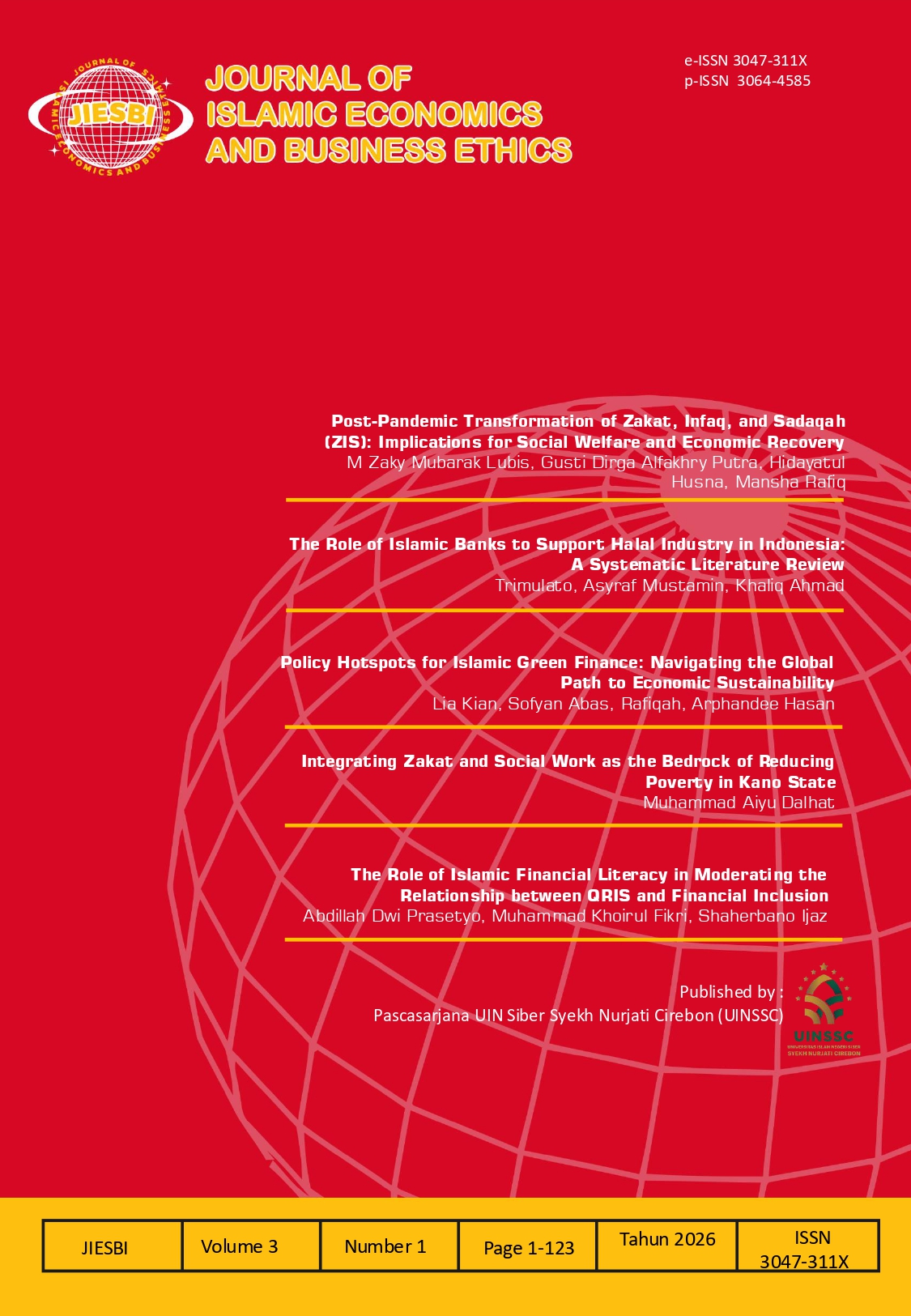
Post-Pandemic Transformation of Zakat, Infaq, and Sadaqah (ZIS): Implications for Social Welfare and Economic Recovery
DOI:
https://doi.org/10.24235/jiesbi.v3i1.397Keywords:
Economic Recovery, Islamic Philanthropy, Post-Pandemic , Transformation, Social WelfareAbstract
This study examines how the collection and distribution of Zakat, Infaq, and Sadaqah (ZIS) transformed during the COVID-19 pandemic. It provides forecasts for 2024, with a particular focus on their implications for social welfare and economic recovery in the post-pandemic era. The study utilized secondary data obtained from BAZNAS monthly reports covering January 2020 to December 2023, a period that captures the initial peak of the COVID-19 crisis and the subsequent recovery phase. Due to the non-normal distribution of the data, the Wilcoxon signed-rank test was employed to assess differences in ZIS collection and distribution between the peak and recovery periods. Additionally, Seasonal Autoregressive Integrated Moving Average (SARIMA) models were applied to forecast future trends. The findings revealed statistically significant differences between the peak and recovery periods in both ZIS collection and distribution, indicating a structural shift in philanthropic behavior and institutional responsiveness after the pandemic. The SARIMA results demonstrated strong capability in capturing seasonal patterns and long-term trends, particularly the pronounced increase in ZIS activities during Ramadan. While the SARIMA model provided a robust foundation for understanding seasonal dynamics and short-term trends, incorporating additional data or hybrid forecasting approaches may enhance predictive accuracy.
References
Anuaruddin, A. S., Abdullah, M. Y., Bhari, A., Yaakob, M. A. Z., Khalid, M. M., Yahaya, M. H. bin, & Adenan, F. (2023). The oustanding business Zakat collection during Covid-19: Case study at pusat pungutan Zakat MAIWP. International Journal of Academic Research in Business and Social Sciences. https://doi.org/10.6007/ijarbss/v13-i7/17810
Arianto, B. (2021). Dampak pandemi COVID-19 terhadap perekonomian dunia. JURNAL EKONOMI PERJUANGAN. https://doi.org/10.36423/jumper.v2i2.665
Assakhiy, R., Anwar, S., & Fitriana, A. R. (2019). Peramalan realisasi penerimaan Zakat pada baitulmal Aceh dengan mempertimbangkan efek dari variasi kalender. Jurnal Ekonomi Pembangunan, 27(2), 27–45. https://doi.org/10.14203/jep.27.2.2019.27-45
Budastra, I. K. (2020). Dampak sosial ekonomi Covid-19 dan program potensial untuk penanganannya: Studi kasus di kabupaten Lombok Barat. Jurnal Agrimansion. https://doi.org/10.29303/agrimansion.v21i1.321
Budiono, & Prasetia, A. (2022). Studi perbandingan hasil uji Wilcoxon pada data hasil pengukuran dan hasil kategori data penelitian kesehatan tingkat stress tekanan darah dan motorik halus. Jurnal Ilmiah Pamenang. https://doi.org/10.53599/jip.v4i2.94
Harahap, H., & , Harahap, Darwis, Aini, I. (2023). Determinan Minat Muzakki Menyalurkan Zakat Perdagangan Melalui BAZNAS Paluta. 4, 228–240.
Hidayanti Daulay, R., & Nasution, J. (2022). Strategi pengumpulan Zakat di masa pandemi Covid 19 (Studi Kasus: LAZ Nurul Hayat Cabang Medan). PESHUM : Jurnal Pendidikan, Sosial Dan Humaniora.
Irfan Syahroni, M. (2023). Analisis data kuantitatif. EJurnal Al Musthafa, 3(3), 1–13. https://doi.org/10.62552/ejam.v3i3.64
Iswandi, A. (2021). Peran lembaga ziswaf dalam distribusi ekonomi pada saat terjadi pandemi Covid-19. Al-Tasyree: Jurnal Bisnis, Keuangan Dan Ekonomi Syariah. https://doi.org/10.59833/altasyree.v13i02.298
Khumaini, S., M. Nurzansyah, & Has, F. (2022). Analysis of the distribution of Zakat, Infaq and Alms at the Baznas Tangerang city during the Covid-19 pandemic. ITQAN: Journal of Islamic Economics, Management, and Finance. https://doi.org/10.57053/itqan.v1i2.10
Kwarteng, S. B., & Andreevich, P. A. (2024). Comparative Analysis of ARIMA , SARIMA and Prophet Model in Forecasting. 5(4), 110–120.
Montgomery, D. C., Jennings, C. L., & Kulahci, M. (2008). Introduction to Time Series Analysis and Forecasting. John Wiley & Sons.
Muhari, S. (2023). Understanding the colletion and distribution of Zakat during Covid-19 pandemic. AKSES: Jurnal Ekonomi Dan Bisnis. https://doi.org/10.31942/akses.v18i1.8682
Mukhlis, A., & Beik, I. S. (2013). Analisis faktor-faktor yang memengaruhi tingkat kepatuhan membayar Zakat: Studi kasus kabupaten Bogor analysis of factors affecting compliance level of paying Zakat: A case study in Bogor regency. Jurnal Al-Muzara’ah.
Napitupulu, R. M., Lubis, R. H., & Sapna, F. P. (2021). Perilaku berzakat di masa pandemi COVID-19. Jurnal Ilmiah Ekonomi Islam. https://doi.org/10.29040/jiei.v7i2.2370
Nasution, D. A. D., Erlina, E., & Muda, I. (2020). Dampak pandemi COVID-19 terhadap perekonomian Indonesia. Jurnal Benefita. https://doi.org/10.22216/jbe.v5i2.5313
Omar, MwanOmar, M. S., & Kawamukai, H. (2021). Comparison between the Holt-Winters and SARIMA models in the prediction of NDVI in an arid region in Kenya using pixel-wise NDVI time series. Academic Journal of Research and Scientific Publishing, 2(23), 1–15. https://doi.org/10.52132/ajrsp/en.2231
Radiansyah, M. (2021). Penghimpunan Dana Zakat di Era New Normal. Al-Muaddib: Jurnal Ilmu-Ilmu Sosial Dan Keislaman.
Ridwan, M. R. S., & Fadilah, S. (2022). Pengaruh pandemi Covid-19 terhadap penghimpunan dana Zakat online di badan amil Zakat nasional. Bandung Conference Series: Accountancy. https://doi.org/10.29313/bcsa.v2i1.1018
Sakinah, N., & Maulana, A. (2021). Peran distribusi harta (Zakat) sebagai solusi ekonomi disaat pandemi Covid-19 pada baznas kabupaten kepulauan Meranti. Kutubkhanah. https://doi.org/10.24014/kutubkhanah.v20i1.13344
Siregar, I. A. (2021). Analisis dan interpretasi data kuantitatif. ALACRITY : Journal of Education, 1(2), 39–48. https://doi.org/10.52121/alacrity.v1i2.25
Yamali, F. R., & Putri, R. N. (2020). Dampak Covid-19 terhadap ekonomi Indonesia. Ekonomis: Journal of Economics and Business. https://doi.org/10.33087/ekonomis.v4i2.179
Zetira, A., & Fatwa, N. (2021). Optimalisasi penghimpunan Zakat digital di masa pandemi. Eqien: Jurnal Ekonomi Dan Bisnis. https://doi.org/10.34308/eqien.v8i2.241
Downloads
Published
Issue
Section
License
Copyright (c) 2025 Journal of lslamic Economics and Bussines Ethics

This work is licensed under a Creative Commons Attribution 4.0 International License.
Authors retain copyright and grant the journal right of first publication with the work simultaneously licensed under a Creative Commons Attribution 4.0 International License that allows others to share the work with an acknowledgement of the work's authorship and initial publication in this journal.
Authors are able to enter into separate, additional contractual arrangements for the non-exclusive distribution of the journal's published version of the work (e.g., post it to an institutional repository or publish it in a book), with an acknowledgement of its initial publication in this journal.
Authors are permitted and encouraged to post their work online (e.g., in institutional repositories or on their website) prior to and during the submission process, as it can lead to productive exchanges, as well as earlier and greater citation of published work (See The Effect of Open Access).