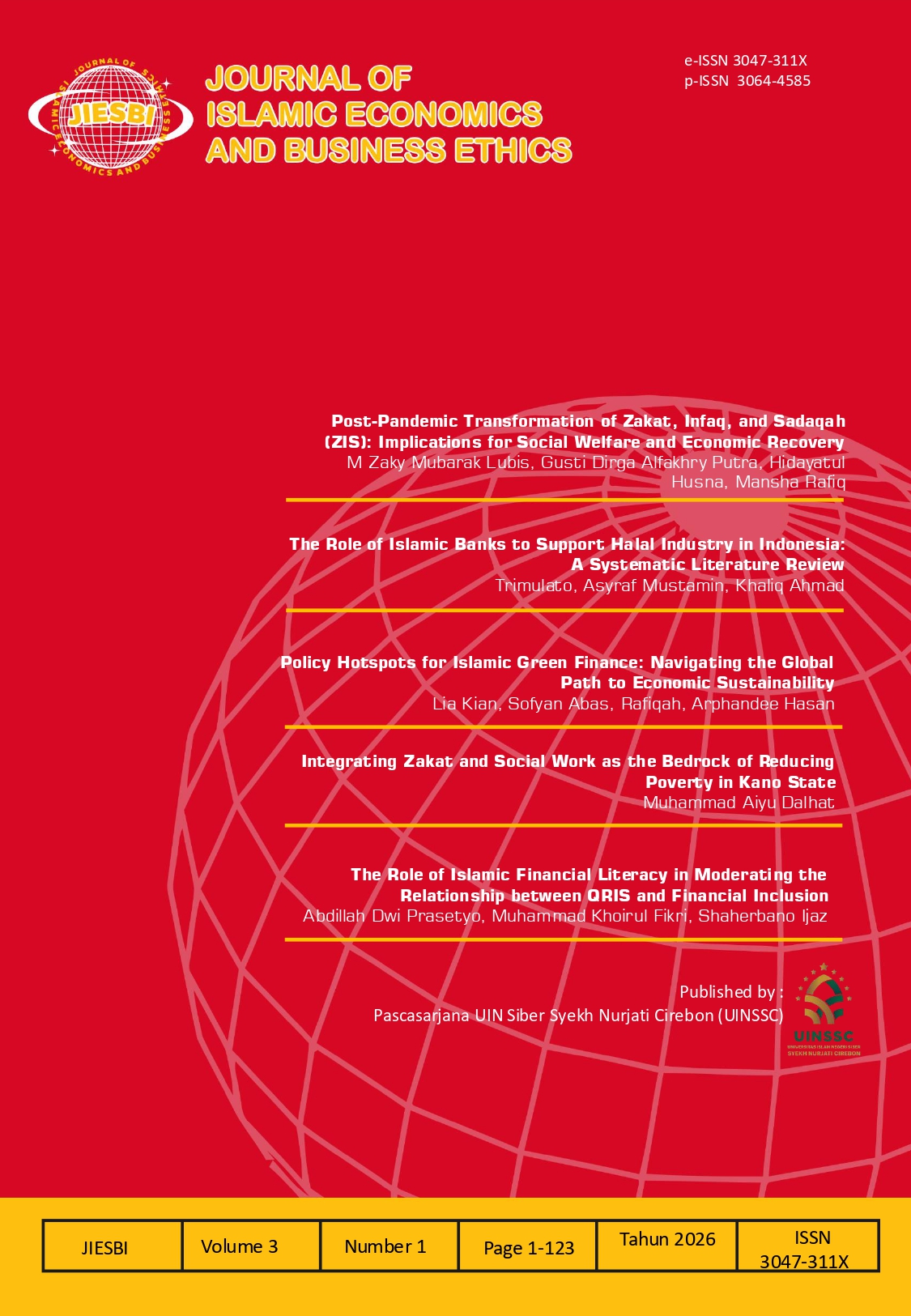
Policy Hotspots for Islamic Green Finance: Navigating the Global Path to Economic Sustainability
DOI:
https://doi.org/10.24235/jiesbi.v3i1.527Keywords:
Green Finance, Hotspot, Policy, SustainabilityAbstract
This study examines the implementation of Islamic green finance through a policy hotspot framework that emphasizes synergy among regulators, Islamic financial institutions, and business actors within the green financing ecosystem. Using a qualitative library-based method with normative, conceptual, and content analysis approaches, this research analyzed secondary data from reports and studies published by the United Nations Environment Programme (UNEP), IMF, World Bank, ICMA, UNDP, IPCC, EIU, and relevant prior studies from 2018 to 2025. The data focused on the development of green finance and Islamic green finance in Europe, Asia, and selected Islamic countries, including Saudi Arabia, the United Arab Emirates, Indonesia, and Malaysia. Based on post-Paris Agreement developments (2018–2022), this study proposed an Islamic green finance model for house building as a policy hotspot to navigate the global path toward sustainable development with social, economic, and environmental impacts. The proposed model consists of four key pillars: (1) Islamic values and principles, including maqāṣid al-sharīʿah, justice (adl), and balance (mizan); (2) Islamic financial instruments such as green sukuk, productive zakat, cash waqf, murabahah, and green ijarah; (3) regulatory and policy support involving green taxonomy, central banks, financial authorities, and ulema councils; and (4) integrated policy implementation grounded in sharia principles. This model is expected to serve as a reference for Indonesia and other countries in developing inclusive and sustainable Islamic green finance.
References
Abakah, E.J.A., Tiwari, A.K., Adekoya, O.B., & Oteng-Abayie, E.F. (2023). Analysis of time-varying causality and dynamic correlation between green bonds and US gas prices. Technological Forecasting and Social Change, 186(A), 122134.https://doi.org/ 10.1016/j.techfore.2022.122134
Abdullah, MS, & Keshminder, JS (2022). What drives green sukuk? A leader's perspective. Journal of Sustainable Finance and Investment, 12(3), 985-1005.https:// doi.org/10.1080/20430795. 2020.1821339
Abubakar, L., & Handayani, T. (2020). Green Sukuk: A sustainable financing instrument for infrastructure development in Indonesia. Proceedings of the 1st Borobudur International Symposium on Humanities, Economics and Social Sciences (BIS-HESS 2019) (pp. 983-987).https://doi.org/ 10.2991/assehr.k.200529.206
Ahmad, M., Ahmed, Z., Bai, Y., Qiao, G., Popp, J., OlAh, J. (2022). Financial inclusion, technological innovation, and environmental quality: Analyzing the role of green openness. Front. Environ. Sci., 10, 851263
Al - Qur'an in surah Al-Baqarah verse 164. Al-Quran and Sunnah.
Al-Mustafa, Muhammad. (2023). The concept of investment according to Sharia economics in the millennial era. Journal of Sharia Economics and Islamic Business, 2(1), 18–27.
Ariyapruchya, S., & Volz, U. (2022). Sustainable finance in Southeast Asia. In D. Schoenmaker, & U. Volz (Eds.), Scaling up sustainable finance and investment in the global south (pp. 281–302). CEPR Press.
Azhgaliyeva, D., Kapoor, A., & Liu, Y. (2020). Green bonds for financing renewable energy and energy efficiency in South-East Asia: A review of policies. Journal of Sustainable Finance & Investment, 10(2), 113-140.
Azmi, Naelul. (2020). Problems of the Islamic economic system in Indonesia. Mutawasith: Journal of Islamic Law, 3(1), 44–64.
Mudassar, B. & Hakim F. Z. (2020). Circular economy: Towards impactful, sustainable and value-based intermediation; international conference on Islamic finance. CIEF conference Report; Center for Islamic Economics and Finance; Hamad Bin Khalifa University.
Beirne. (2020). Financial cycles in asset markets and regions. Economic Modelling, 92, 358-374. https://doi.org/10.1016/j.econmod.2020.01.015
Bhattacharyya, R. (2022). Green finance for energy transition, climate action and sustainable development: Overview of concepts, applications, implementation and challenges. Green Finance, 4(1), 1–35. https://doi.org/10.3934/gf.2022001
Bilgies, Fitriyatul A., Fauzan, Rusydi, Wahyudi, Ickhsanto, Syahrir, Nurwahyuni, Nugroho, Lucky, Aziz, Mochamad R., Usadha I., Nyoman D., Maulidizen, Ahmad. (2023). Islamic Financial Management. Global Technology Executive.
Che, C., Chen, Y., Zhang, X., Zhao, L., Guo, P., and Ye, J. (2021). Study on emission reduction strategies of dual-channel supply chain considering green finance. Front. Environ. Sci. 9, 687468. doi:10.3389/fenvs.2021.687468
Cai, R.; Guo, J. (2021), Finance for the environment: A scientometric analysis of green finance. Mathematics,9, 1537.
Amri, C. E., Mohammed M., Omar M., & Mohamed H. A. (2021). How does the green sukuk structure contribute to SDGs? Islamic Wealth and the SDGs
Clark R., Reed J., Sunderland T. (2018). Bridging the financing gap for climate and sustainable development: Pitfalls, progress and potential of private finance. Land Use Policy, 71, 335–346.
Cortellini, G., & Panetta, I.C. (2021). Green bonds: A systematic literature review for a future research agenda. Journal of Risk Management and Finance, 14(12), 589.https://doi.org/10.3390/ jrfm14120589
Diaz-Rainey, I., Robertson, B., & Wilson, C. (2017). Stranded research? Leading finance journals are silent on climate change. Climatic Change, 143(1), 243–260. https://doi.org/10.1007/s10584-017-1985-1
D'Orazio, P. (2023). A global database for climate-related financial policies. BMC Research Notes, 16(1). https://doi.org/10.1186/s13104-023-06418-8
Dmuchowski, P., Dmuchowski, W., BaczewskaDąbrowska, A.H., Gworek, B. (2021). Green economy growth and maintenance of green growth conditions at the local authority level in Poland. J. Net. Prod., 301, 126975
Fadzlurrahman, F., & Abubakar, L. (2019). Risk allocation in sukuk-based project financing to realize the ease of doing business. Journal of Jurisprudence, 9(2), 133-148. (In Indonesian).https://doi.org/10.23917/ jurisprudence.v9i2.8073
Fitrah, R., & Soemitra, A. (2022). Green sukuk for sustainable development goals in Indonesia: A literature study. Scientific Journal of Islamic Economics, 8(1), 231-240.http://dx.doi.org/10.29040/jiei. v8i1.4591
Gesalegn, G.; Tangl, A. (2022). Enhancing green finance for inclusive green growth: A systematic approach. Sustainability 14.7416. https://doi.org/ 10.3390/su14127416
Giramkar, S. (2018). Green banking in India: A study for sustainable development. In Proceedings of the 10th Economics & Finance Conference; No. PG-138-152; International Institute of Social and Economic Sciences: London, UK, 138–152.
Güçlü, F. (2019). Rising environmental awareness in Islamic finance: Green sukuk. In Handbook of Energy and Environmental Policy, (245-259). https://doi.org/10.21580/jdmhi.2024.6.2.23093
IPCC. (2018). Global warming of 1.5°C. An IPCC special report on the impacts of global warming of 1.5°C above pre-industrial levels and related global greenhouse gas emission pathways, in the context of strengthening the global response to the threat of climate change, sustainable development, and efforts to eradicate poverty. Edited by V. Masson-Delmotte, P. Zhai, H.-O. Pörtner, D. Roberts, J. Skea, P.R. Shukla, A. Pirani, W. Moufouma-Okia, C. Péan, R. Pidcock, S. Connors, JBR Matthews, Y. Chen, X. Zhou, MI Gomis, E. Lonnoy, T. Maycock, M. Tignor, and T. Waterfield.https://www.ipcc.ch/site/assets/uploads/sites/2/2019/05/SR15_Citation.pdf
Karim, S., & Naeem, M.A. (2022). Do global factors drive the linkages between green, Islamic, and conventional financial markets?. International Journal of Managerial Finance, 18(4), 639-660. https://doi.org/10.1108/IJMF-09-2021-0407
Kasnelly, S. (2021). Sukuk in the development of Islamic finance in Indonesia. AKTUALITA Journal of Social and Religious Research, 11 (1), 1–14. Retrieved from: http://www.ejournal.an-nadwah.ac.id
Keshminder, J. S., Singh, G. K. B., Wahid, Z. A. B., & Abdullah, M. S. (2019). Green sukuk: Malaysia takes the lead. Malaysian Journal of Consumer and Family Economics, 22(2), 1-22. Retrieved from https://www.majcafe.com/green-sukuk-malaysia-taking- thelead/
Kian, L (2018), Political and religious contributions in economic development. IJBE (Integrated Journal of Business and Economics) 104-104. https://doi.org/10.33019/ijbe.v2i1.63https://www.webofscience.com/wos/alldb/full
Laldin, MA, & Djafri, F. (2021). The role of Islamic finance in achieving sustainable development goals (SDGs). In Islamic Finance and Sustainable Development: A Sustainable Economic Framework for Muslim and Non-Muslim Countries (pp. 107–126). Springer International Publishing.https://doi.org/10.1007/978-3-030-76016-8_6
Lanzara, F. (2021). Islamic finance and sustainable development goals. A bibliometric analysis from 2000 to 2021. European Journal of Islamic Finance, 18, 1-19. https://doi.org/ 10.13135/2421-2172/5765
Lee, K. H., & Min, B. (2015). Green R&D for eco-innovation and its impact on carbon emissions and firm performance. J. Clean. Prod. 108, 534–542. Htpps://doi.org/10.1016/j. jclepro.2015.05.114
Liu, FHM, & Lai, KPY (2021). Green financial ecology: Green sukuk and the development of green Islamic finance in Indonesia. Malaysia. Environment and Planning A: Economics and Space, 53(8), 1896-1914.https://doi.org/ 10.1177/0308518X211038349
Lv, C., Shao, C., Lee, C. C. (2021). Green technology innovation and financial development: Do environmental regulations and innovation outcomes matter? Energy Economics, 98, 105237.
Mahargiyantie, Sri. (2020). The strategic role of Indonesian Sharia banks in the Sharia economy in Indonesia. Al-Misbah, 1(2), 199–208.
Menon, R. (2022). What does it take to get to net zero? Keynote speech by Mr Ravi Menon, Managing Director of the Monetary Authority of Singapore, at the Economic Society of Singapore Annual Dinner 2022, Singapore, 17 August 2022.https://www. bis.org/review/r220819a.pdf.
Mufid, Moh. (2021). Philosophy of Islamic economic law: A study of the ontology, epistemology, and axiology of contemporary muamalah contracts. Prenada Media.
Syahrul, M., Umi, M., Ahmad, F., & Santi, M. (2020). Green Sukuk: Indonesian youth investment prospects for environmental sustainability. Journal of Economics, Business, and Organization Research, 140-147
Musari, K. (2022). Integration of green sukuk and cash Waqf-linked sukuk, a hybrid Islamic financial instrument in Indonesia: A proposed model to combat climate change. International Journal of Islamic Treasury, 12 (2), 133–144. https://doi.org/10.15575/ijik.v12i2.17750
Nasim, I., Chaudhry, I.S., & Bashir, F. (2022b). Effects of trade, environmental quality and human capital on industrial sector output in developing countries: A panel data analysis. iRASD J. Eco. 4(1), 107–116.doi:10.52131/joe.2022.0401.0065
Naz, F.; OlAh, J.; Vasile, D.; Magda, R. (2020). Green purchasing behavior of university students in Hungary: An empirical study. Sustainability, 12, 10077. [Cross-reference]
Nisar, Q.A., Akbar, A., Naz, S., Haider, S.A., Poulova, P., & Hai, M.A. (2022). Greening the workforce: A strategic way to spur the environmental performance in the hotel industry. Front. Environ. Sci. 110.doi:10.3389/fenvs. 2022.841205
Noviarita, Heni, Kurniawan, Muhammad, & Nurmalia, Gustika. (2021). Analysis of halal tourism in increasing the rate of economic growth in Lampung province. Scientific Journal of Islamic Economics, 7(1), 302–310.
Nurcahyo, Jannah, R., Anis, M., Avianda, S. (2024). Management of maqasid syariah in realizing sustainable development goals: Perspective of the halal tourism industry. Journal of Digital Marketing and Halal Industry.
Nurmalika, Arifah, & Sisdianto, E. (2025). The influence of environmental awareness on the implementation of environmental accounting in the micro, small, and medium enterprises (MSMEs) Sector. Arifah Nurmalika 2(1), 84–92.
Peng, J., and Zheng, Y. (2021). Does environmental policy promote energy efficiency? Evidence from China in the context of developing green finance. Front. Environ. Sci. 299. https://doi.org/10.3389/fenvs.2021.733349
Polzin, F.; Migendt, M.; Täube, F.A.; Von Flotow, P. (2015). The influence of public policy on renewable energy investment—A panel data study across OECD countries. Energy Policy, 80, 98–111.
Rafiq, M., Akbar, A., Maqbool, S., Sokolová, M., Haider, S.A., Naz, S. (2022). Corporate risk tolerance and acceptability towards sustainable energy transition. Energies, 15(2), 459. https//doi.org/10.3390/en15020459
Rani, L. N., Laila, N., Filianti, D., & Ramadhani, D. W. (2022). Analysis of sukuk research in Indonesia using a bibliometric approach. Al-Muzara'ah, 43-56. https://doi.org/10.29244/jam.isucepat2022.43-56
Setyowati, A. (2023). Governing sustainable finance: Insights from Indonesia. Climate Policy, 23(1), 108–121. https://doi.org/10.1080/14693062. 2020.1858741
Shan, S., Lin, Z., Li, Y., & Zeng, Y. (2018). Attracting Chinese FDI in Africa: The role of natural resources, market size and institutional quality. Crit. Perspect. Int. Bus. 14,139–153. https://doi.org/10.1108/cpoib-11-2016-0055
Soemitra, A. (2012). The Rationality of the Presence of Sharia Economics and Finance
Suud Sarim Karimullah. (2025). Islamic economic justice as an alternative solution to the global economic crisis. HEI EMA Journal, 4(1), 133–52.
UNDP. (2020). Pioneering the Green Sukuk in Indonesia. UNDP. https://www.undp.org/stories/pioneering-green-sukuk-indonesia
UNEP FI. (2023). Aligning climate policy engagement with net-zero commitments: A foundation for asset owner engagement of asset managers. https://www.unepfi.org/industries/aligning-climate-policy-engagement-with-net-zero-commitments/.
Volz, U. (2019). Fostering green finance for sustainable development in Asia. In U. Volz, P. J. Morgan, & N. Yoshino (Eds.), Routledge handbook of banking and finance in Asia (pp. 488–504).
Volz, U., Beirne, J., Ambrosio Preudhomme, N., Fenton, A., Mazzacurati, E., Renzhi, N., & Stampe, J. (2020). Climate change and sovereign risk. SOAS University of London, Asian Development Bank Institute, World Wide Fund for Nature Singapore, Four Twenty Seven. https://doi.org/10.25501/SOAS.00033524
World Bank. (2020). Pioneering the Green Sukuk: Three Years On. World Bank, Washington, DC.
World Bank. (2020). The World Bank Sustainable Development Bonds & Green Bonds
Xie, Y., Jiang, J., Wang. (2024). Greenance policy and labor demand: Evidence from China. Pac.-Basin Financ. J., 86, 102434
Downloads
Published
Issue
Section
License
Copyright (c) 2026 Journal of lslamic Economics and Bussines Ethics

This work is licensed under a Creative Commons Attribution 4.0 International License.
Authors retain copyright and grant the journal right of first publication with the work simultaneously licensed under a Creative Commons Attribution 4.0 International License that allows others to share the work with an acknowledgement of the work's authorship and initial publication in this journal.
Authors are able to enter into separate, additional contractual arrangements for the non-exclusive distribution of the journal's published version of the work (e.g., post it to an institutional repository or publish it in a book), with an acknowledgement of its initial publication in this journal.
Authors are permitted and encouraged to post their work online (e.g., in institutional repositories or on their website) prior to and during the submission process, as it can lead to productive exchanges, as well as earlier and greater citation of published work (See The Effect of Open Access).